Dorm Room Mockup Guide: How to Present Bedding, Wall Art, Rugs & Decor


Nobody decorates a dorm room one product at a time. A shopper may arrive at your listing looking for a duvet cover while already picturing it next to a rug, a panel of removable wallpaper and the desk the university bolted to the wall. Good dorm mockups work the same way: each product shown clearly on its own, plus a full-room scene that proves the designs belong together.
The timing matters, too. Google's July 2026 back-to-college data showed breakout interest in "3D rendering dorm room" and "dorm room wallpaper," while searches for "dorm designer" grew by 525%. Coastal, boho and beach led the fastest-rising dorm styles.
If you sell dorm decor online, in any form, none of this means your images need to look like a viral room-makeover reel. It means shoppers are actively trying to picture finished rooms. Help them do it, believably, and you have an advantage over every seller still showing a flat pattern swatch.
What should a dorm-focused product listing show?
Two kinds of images, doing two different jobs. A full-room mockup sets the mood and lets the shopper imagine the finished space. Product-focused views show pattern scale, texture and detail. You need both.
A strong listing sequence looks like this:
A clear main image. Lead with the product and a design that still reads at thumbnail size. If a stranger can't tell what you're selling in two seconds, nothing else in the listing matters.
A styled room view. Show how the product contributes to the wider dorm room look.
A closer detail. The pattern repeat, textile texture, print edge, rug finish or wallpaper surface.
A scale reference. Dimensions, a size chart, or an angle that makes the proportions obvious.
Available colors or patterns. Present variations consistently so shoppers can compare them without guessing.
A coordinated collection image. The same design family working across two or three products.
This also matches Etsy's current listing guidance: use the first image to attract attention, then add angles, close-ups and lifestyle shots that help shoppers decide.
One caveat before you build the set. Check the image rules of whatever marketplace you sell on. On Etsy, mockups are the standard way to present digital downloads and print-on-demand designs produced with a production partner. The restrictions sit elsewhere: physical handmade items need real photos, and the first image of a personalized listing must show a finished, customized example. A "your text here" placeholder can't be the main photo.
Bedding: make pattern scale easy to judge
Bedding is usually the largest patterned surface in the room, so the scale of the artwork decides the final look more than anything else. Start with a front or perspective view showing how the design sits across the duvet and pillows. Follow with a closer crop of the repeat, then a wider bedroom scene for the complete styling. A bedding mockup with separate smart objects for the duvet, pillowcases and cushions covers all three views from one file.
Here is the mistake we see most often when designers share their previews: the same pattern, at the same scale, on every textile. Real bedding sets never look like that. They mix scales: a larger motif on the duvet, a tighter coordinate on the pillowcases, a quieter design on the decorative cushion. Copy that logic and the set immediately looks intentional.
One practical note for US college shoppers. Confirm the actual bedding size before writing "Twin XL" in the listing. Many residence halls use 80-inch mattresses; UW–Madison, for example, lists beds at 33 × 80 or 36 × 80 inches and recommends Twin XL sheets for all of them.
Make these details easy to find:
the scale of the main pattern;
the number of included pieces;
how the duvet and pillow designs relate;
available sizes and colorways;
any contrasting reverse side, piping or trim.
Wall art: combine context with a clear view of the design
A styled bedroom mockup answers the question shoppers actually have: how will this print look above a bed, a desk or a storage unit? It gives the artwork scale and an interior style to live in. Just don't let the context swallow the art. Most wall art mockups include a straight-on view alongside the styled scene; use it, so the design isn't reduced to a small decorative detail in the background.
For wall art sets, show the exact number of prints, the orientation, the arrangement and spacing, the available dimensions or aspect ratios, and whether frames and surrounding decor are included. That last point deserves its own sentence in the listing. When you sell digital art, say plainly that the frame and the props are styling, not product. It's a one-line note, and it prevents the most common source of "this isn't what I ordered" messages.
Rugs: show both the design and the floor coverage
A rug introduces color, defines a study corner or visually connects several parts of a small room. The mockup has to show two things: the pattern and the footprint. Pair an angled lifestyle view with a top or near-overhead shot; a good rug mockup gives you both angles. The wider scene gives the rug context; the overhead view makes the shape and pattern easy to inspect. Keep the full outline visible, especially when the rug has rounded corners, tassels or a distinctive binding, and add a close crop of the repeat and texture for patterned designs.
Sizes need honest treatment, too. Enlarging the same render for every size option makes a 3×5 and a 5×8 look nearly identical, or blows the pattern up to an unrealistic scale. Adjust the artwork for each listed dimension.
Wallpaper: show the room transformation
Wallpaper is the timeliest category on this list. Google reported "dorm room wallpaper" as a breakout search in July 2026, which makes sense: nothing changes a small rented room faster.
Before-and-after sells it. Show the room with a plain wall, then repeat the identical composition with the wallpaper applied. Same furniture, same light, one variable. Nothing distracts from the transformation; an interior wallpaper mockup with an editable wall layer produces both frames from a single file.
Then get close. Shoppers deciding on wallpaper want to inspect the pattern repeat, the scale of the motif, how neighboring panels meet, the surface texture and the available colorways. Give them a crop where they can.
And a warning we'd rather give twice than not at all: "removable," "peel-and-stick," "renter-friendly" and "dorm-approved" are product claims, not styling choices. Use them only when the physical product specification backs them up. Residence hall rules differ, and an overclaim here lands on the buyer.
How to coordinate several patterns without making the room feel chaotic
Not by repeating one print on every surface. The same design at the same size on the bedding, rug, wallpaper and pillows feels flat at best and overwhelming at worst. Start with one hero design, then a supporting pattern and a quieter coordinate. Repeat a limited color palette across the room while varying the scale, density and type of motif. In practice: a larger botanical repeat on the duvet, a smaller geometric coordinate on the pillowcases, a subtle stripe or texture on the rug, and one simplified motif or shared color carried into the wall art.
Wallpaper can play either role. As a lower-contrast supporting design it lets the bedding lead; as the main feature it asks the bedding to calm down. Decide which product you want shoppers to notice first, then build the room around it.
On trend keywords: describe the collection you actually made. A blue design is not automatically coastal, and a floral repeat is not necessarily cottagecore. "Coastal dorm decor," "boho dorm bedding" and "floral dorm wallpaper" are useful phrases when they're true.
Test the collection in one room before creating separate listings
Before exporting individual product images, drop the whole collection into one editable interior scene. Competing patterns, oversized artwork and spots that need a quieter surface all show up immediately when the designs share a room. Reviewed one product at a time, they hide.
The Cottage Style Bedroom Bedding Mockup was built for exactly this kind of test: bedding, decorative pillows, wallpaper, framed wall art and a rug in a single interior, so you can compare pattern scale and color balance across every surface at once.
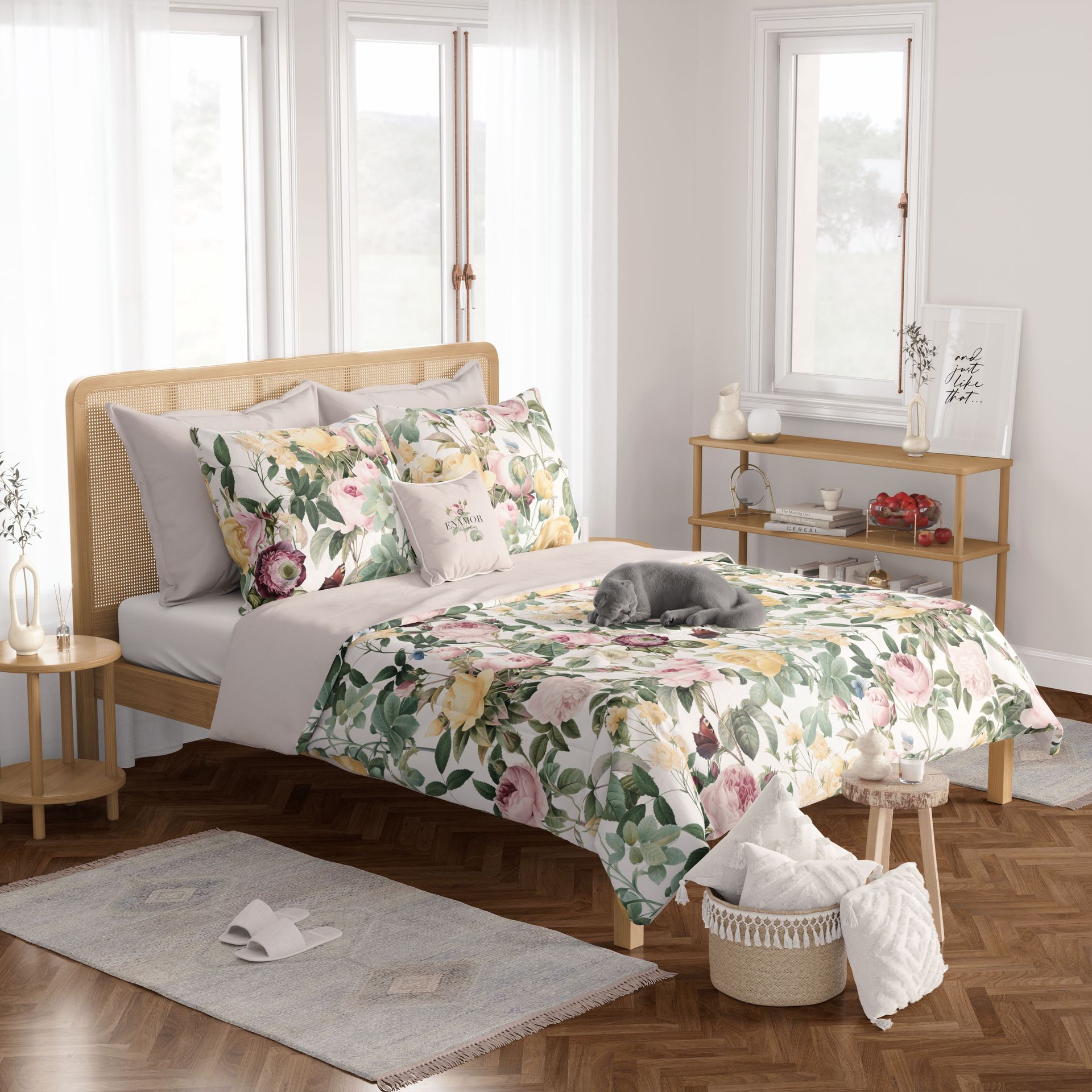
When the room feels balanced, export the cleaner product-focused images for the individual duvet, artwork, rug or wallpaper listings. The full-room scene then becomes the image that connects them.
FAQ
What size is a dorm room bed?
Most US residence halls use Twin XL mattresses around 80 inches long, but widths vary by school. UW–Madison, for instance, lists beds at 33 × 80 or 36 × 80 inches and recommends Twin XL sheets for all of them. Check the specific school's housing page before labeling bedding sizes.
How many images does a dorm decor listing need?
Aim for six: a clear main image, a styled room view, a close detail, a scale reference, the available colorways and a coordinated collection shot. Together they do both jobs a listing has: making the product legible and helping the shopper imagine the finished room.
Can students actually use wallpaper in dorm rooms?
Often yes, with removable peel-and-stick products, but every residence hall sets its own rules. As a seller, claim "removable" or "dorm-approved" only when the product specification supports it, and encourage buyers to check their housing guidelines before ordering.
Should every product in a collection use the same pattern?
No. Use one hero pattern, one supporting coordinate and one quiet design, tied together by a shared color palette. Vary the scale and density across the bedding, rug, wallpaper and art. That variation is what makes the set feel deliberately designed.
Are mockup images allowed on marketplaces like Etsy?
Yes, in the situations dorm decor sellers usually care about. Digital downloads and print-on-demand designs produced with a production partner can be presented with mockups on Etsy. Physical handmade items need real photos, and a personalized listing's first image must show a finished, customized example. Check each marketplace's current policy.
Dorm room product listing checklist
Before publishing, check that:
the product is identifiable within a few seconds;
the main design stays clear at mobile thumbnail size;
the pattern scale looks believable on every surface;
important details appear in at least one closer view;
dimensions and included pieces are easy to find;
product variations are presented consistently;
props cannot be mistaken for part of the purchase;
the product stays the focal point of the full-room scene;
the listing follows the marketplace's current image requirements.
A dorm shopper is furnishing the first room of their own, usually on a budget and a deadline. The close-ups earn trust. The room scene sells the feeling. Do both well and shoppers stop comparing products and start planning their rooms around yours.
Ready to build the set? Start where this guide did: drop your whole collection into one full bedroom scene and look at it the way your shopper will: as a room, not a product grid.


