Why Pattern Designers Should Use Mockups


In short: a flat repeat proves your pattern tiles correctly; a mockup shows what it sells as. Seeing the pattern on fabric, kids’ clothing, wallpaper, bedding, or packaging lets buyers and art directors judge scale and product fit at a glance, instead of imagining it.
A square repeat is useful. It shows the artwork clearly, proves the pattern tiles correctly, and helps clients and buyers read the structure of a design. But a flat square isn’t always enough.
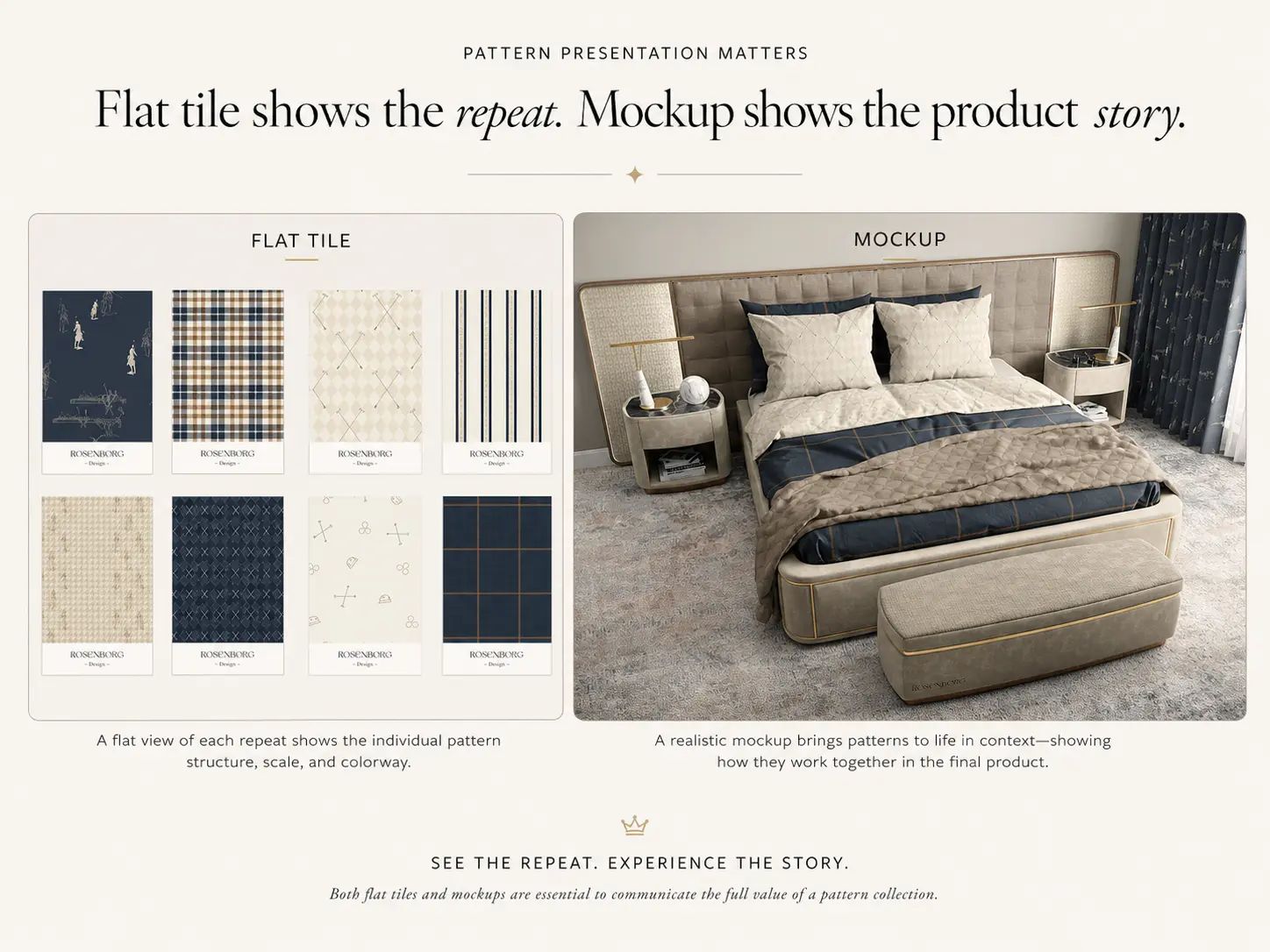
Plenty of surface pattern designers still present their work mainly as a digital repeat on a white background, and there’s nothing wrong with that. A technical repeat matters, especially when you’re licensing artwork or preparing a collection. But if it’s the only way you show a pattern, you’re asking people to do a lot of imagining: the buyer has to picture it on fabric, the brand on packaging, the parent on kids’ clothing, the interior designer on wallpaper or bedding. A mockup closes that gap. It turns a flat file into something people read as a real product.
“I love how the mockup from Creatsy helps me show the vibe of this in an elegant, yet down to earth way.”
- Anette Heiberg
That’s the part a flat square struggles with on its own. A square shows the repeat; a mockup shows the vibe.
Why mockups matter for surface pattern designers
Surface patterns aren’t made to live on a screen. They’re made for surfaces: fabric, wallpaper, bedding, packaging, clothing, home decor, and more. Show a pattern as a flat square and you’re showing the artwork; show it on a mockup and you’re showing the artwork in context.
Context is what helps people read scale, product fit, mood, and commercial potential. A good mockup doesn’t replace the repeat file. It makes the repeat easier to sell.
Pattern scale is easier to read on a product
Scale is one of the hardest things to judge from a square. A pattern can look beautiful as a repeat and behave completely differently once it’s sized onto a real object.
A tiny floral can feel delicate on baby clothes but busy on a large wall.
A big botanical can look stunning on wallpaper but oversized on a small pouch.
A bold geometric can carry upholstery but overwhelm children’s pajamas.
Mockups let you test this visually, and they let clients understand the intended use without a paragraph of explanation. Instead of saying “this would be perfect for nursery textiles,” you show it on a swaddle, kids’ bedding, or a nursery scene. The visual proof is far stronger.
Why kids’ clothing mockups are so effective
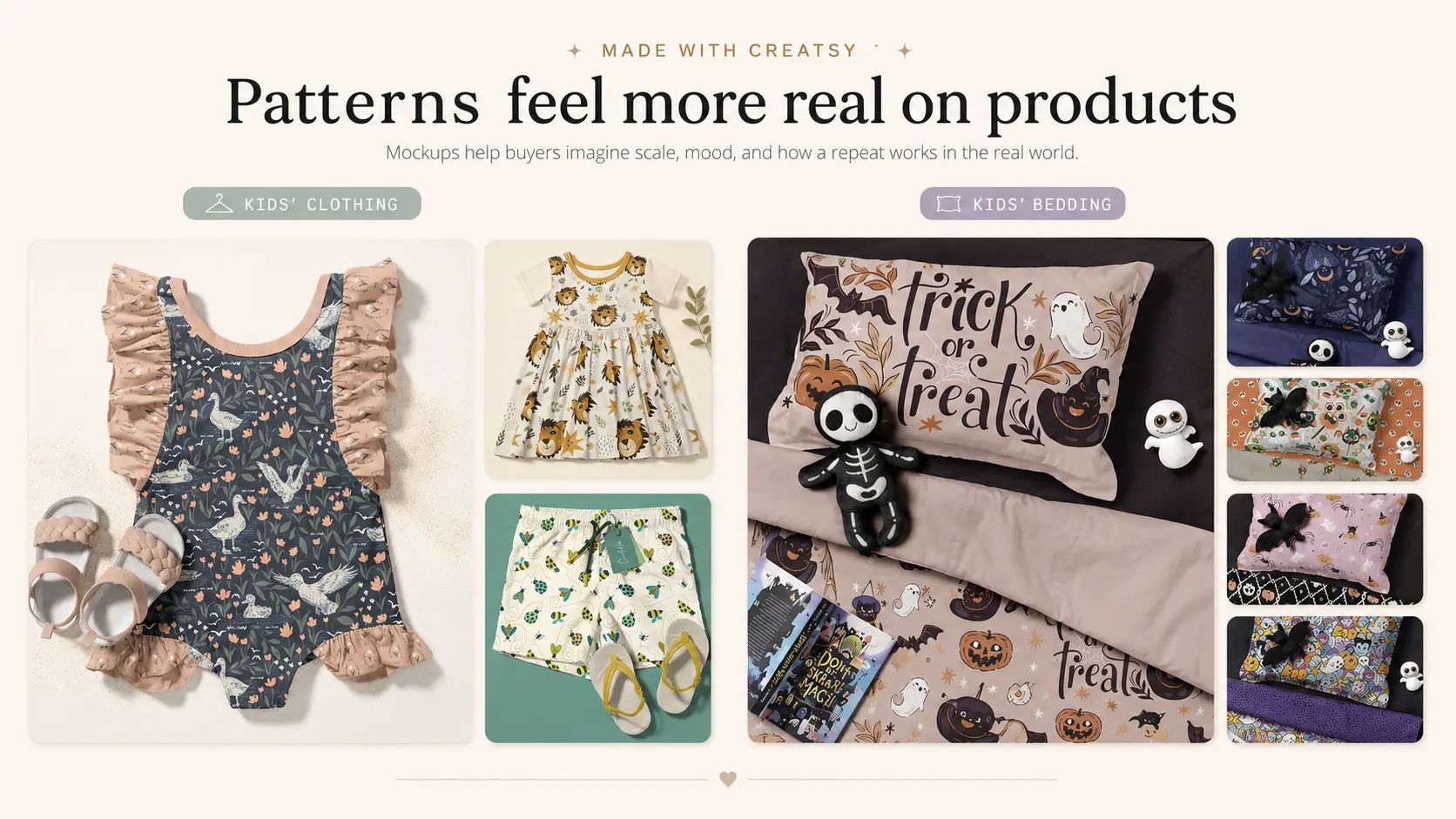
Children’s products lean heavily on pattern, which makes them one of the strongest categories for surface design. A playful repeat can look cute as a square, but placed on a baby ruffle swimsuit, a toddler pajama set, or nursery bedding, it suddenly becomes emotional and easy to understand. Parents and buyers don’t just see a repeat; they see a product.
That matters because kids’ designs are often bought on feeling. Is it sweet? Is it fun? Is it giftable? Does it fit a nursery theme? A mockup answers those questions in a second, and it also shows whether a design holds up at a smaller scale, which is useful for ditsy florals, tiny icons, animal prints, and seasonal collections.
“I love how this design also works for kids swimwear.”
- Patricia Sodre
That’s a mockup working as a discovery tool. A pattern that began as a flat repeat can reveal a whole new commercial direction once it lands on swimwear, bedding, wallpaper, or packaging.
Why wallpaper mockups show large-scale impact
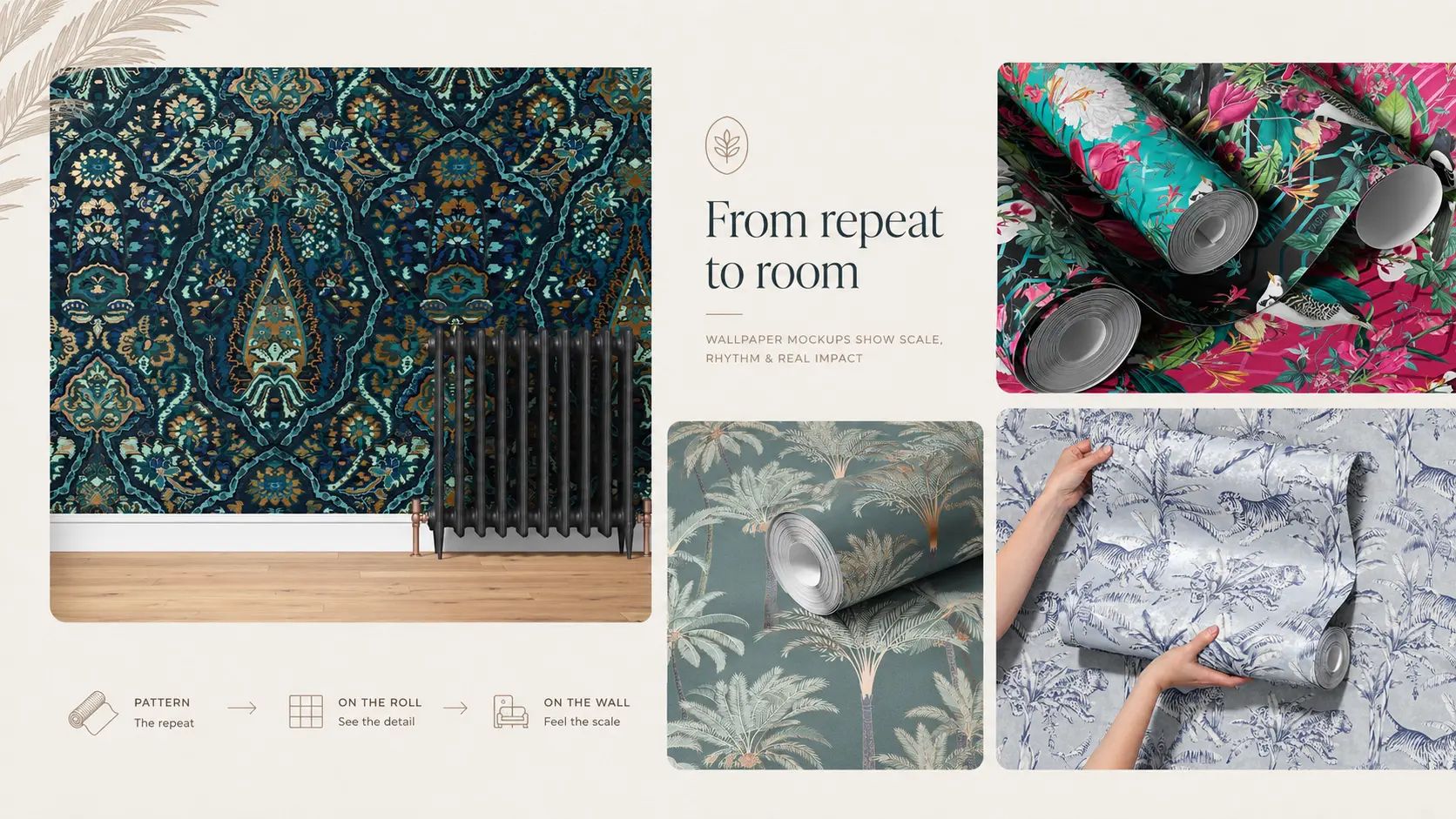
Some patterns need room. A wallpaper mockup shows how a design behaves across a wall, including its rhythm, density, color balance, and overall impact, which matters most for botanicals, large florals, geometric repeats, murals, and maximalist interiors.
A wall can change how a pattern reads entirely. A large floral that feels crowded in a square tile can feel elegant and immersive at full scale; a geometric that looks flat in a crop can create structure and movement in a room. Wallpaper mockups also show how the pattern sits with furniture, light, and wall height, which a repeat tile can’t communicate on its own.
“This mockup is gorgeous! Thank you for creating the most beautiful spaces!”
- Anna Goldar
That’s what interior mockups do: they don’t just display a pattern, they build a space around it.
Why upholstery and sofa mockups signal commercial confidence
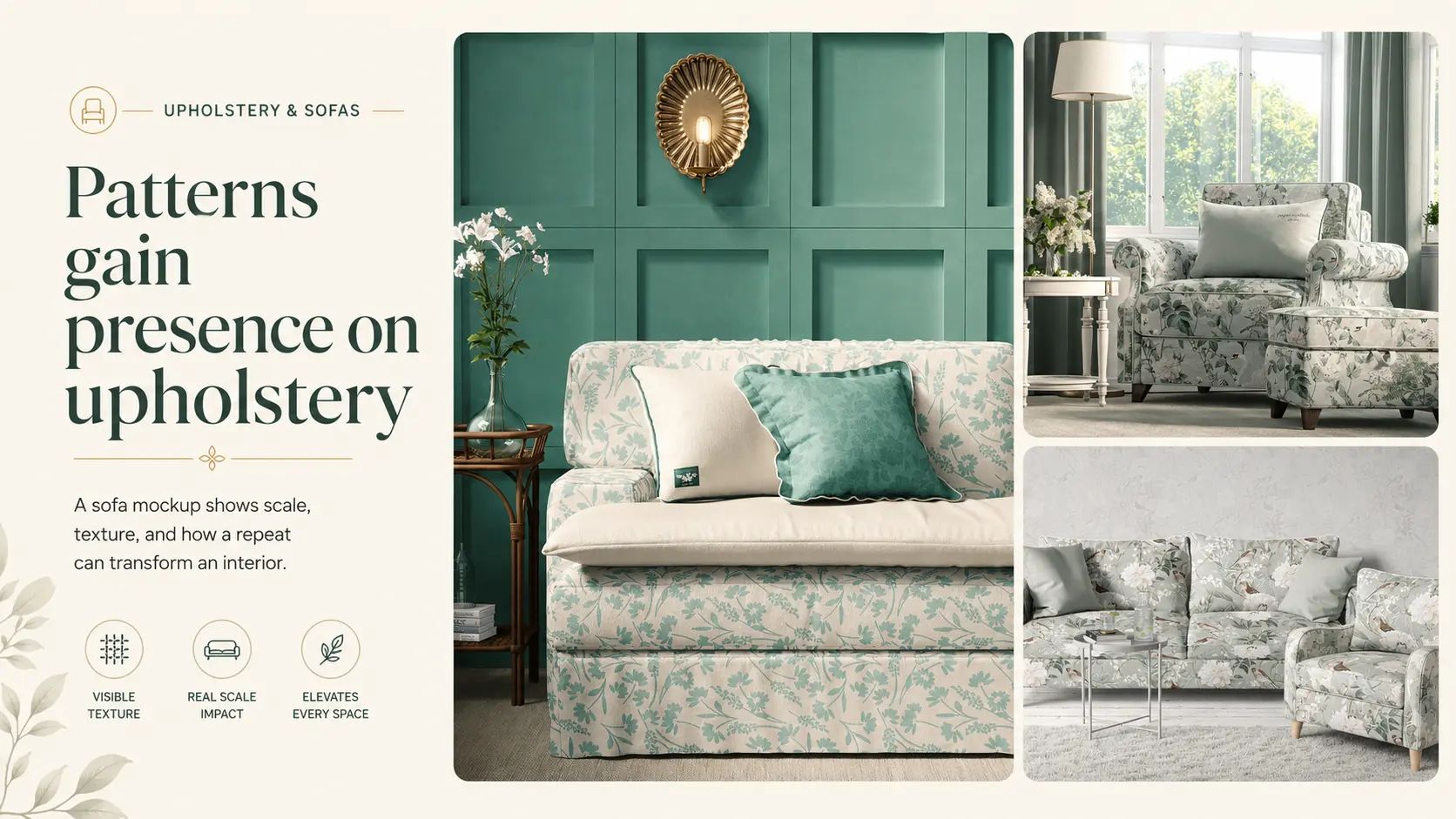
Upholstery mockups are valuable for designers positioning their work in home decor, interiors, or licensing. A pattern on a sofa reads differently from a pattern in a square: it has volume and presence, it interacts with light, and it becomes part of a room.
Upholstery is a high-impact surface, so a sofa, armchair, or cushion shows whether a pattern is strong enough to carry a larger product. For florals, geometrics, stripes, botanicals, or vintage-inspired motifs, it makes the work feel editorial and market-ready, and it helps buyers imagine the design beyond fabric-by-the-yard, in interiors, furniture, hotels, and lifestyle brands. That’s a bigger story than a flat square tells.
Why bedding and nursery mockups add emotional context
Bedding gives a pattern room to breathe across pillows, duvet covers, sheets, and full-room scenes. For children’s patterns especially, a nursery or kids’ bedding mockup helps the viewer picture the design in a real room rather than on a file.
That context matters for seasonal and themed prints like Halloween, Christmas, animals, florals, or stars and moons. Shown in a bedroom scene, a pattern becomes part of a mood and a story, which makes it more memorable.
Why fabric mockups are essential for textile designers
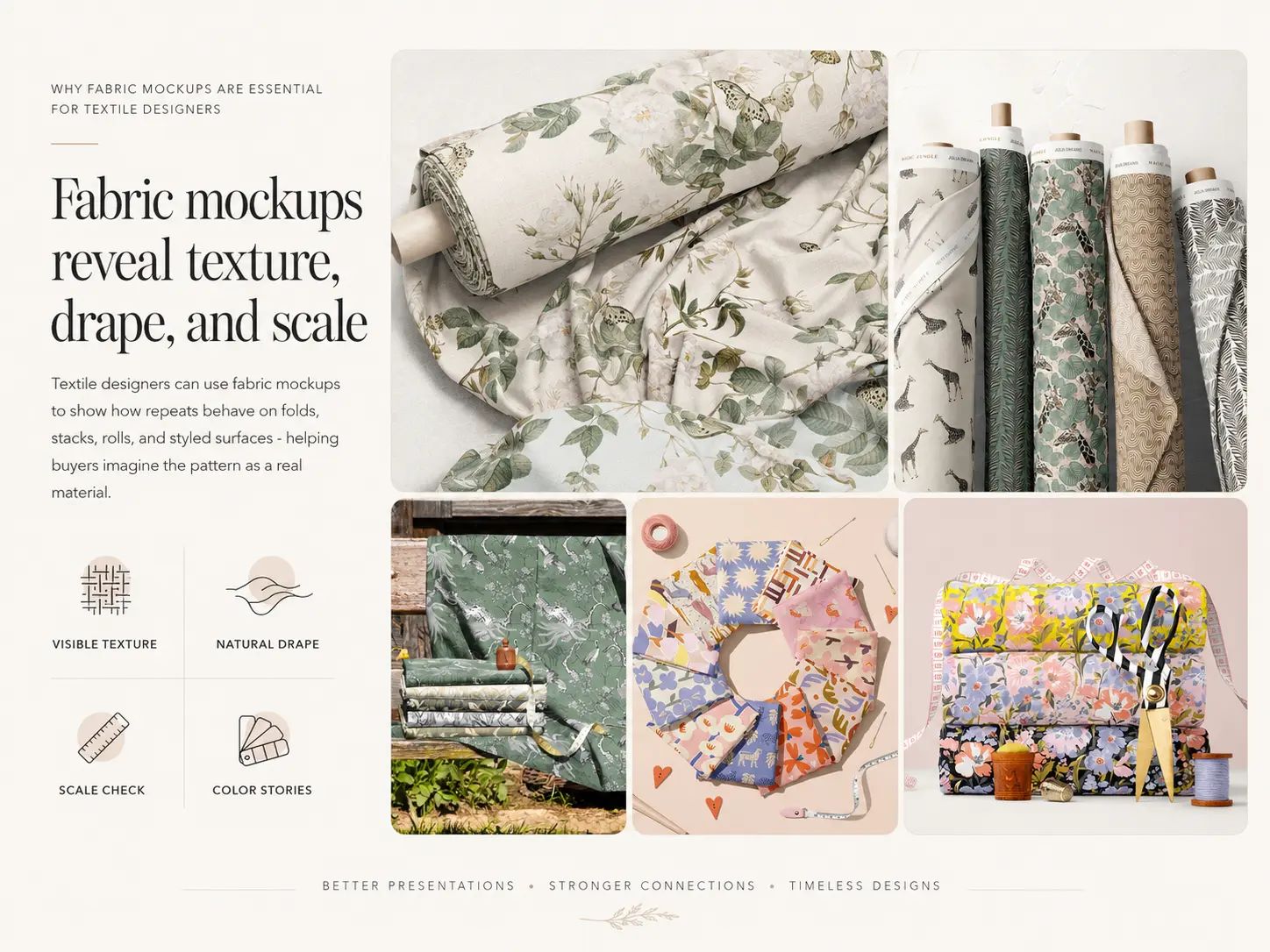
A fabric mockup is the most direct way to show a pattern as a textile. It shows how the repeat behaves on folds, drape, and soft surfaces, which a flat square can’t do, because a square can’t show movement.
That’s useful for textile and fashion-print designers, Spoonflower sellers, fabric shops, and licensing artists who need to show how artwork reads on real material. A fabric mockup communicates softness, scale, texture, and repeat density at a glance. A lemon floral on folded fabric instantly feels more tactile than the same tile flat, and the viewer can already imagine it as clothing, napkins, scarves, or bedding.
If textiles are your market, start from a surface that already matches it: our Fabric Mockups cover cotton, linen, silk, velvet, canvas, and other textile surfaces made for pattern creators and fabric brands.
Mockups help you build a stronger portfolio
A surface pattern portfolio should show more than artwork; it should show commercial thinking. Mockups let you organize each pattern into a small product story instead of one square after another: repeat preview, close-up detail, fabric mockup, product mockup, lifestyle scene, and colorway comparison.
That makes a portfolio far easier to read for art directors, licensing agents, print-on-demand sellers, and clients, and it signals that you understand where the pattern could live.
“One of my favorite things to do is to do a mock-up of all my different patterns.”
- Catherine Endres
Mockups don’t have to be a final marketing chore. They can be part of the process: a way to test scale, compare collections, and spot which patterns have the strongest potential.
Mockups make social posts and shop visuals more clickable
On Instagram, Pinterest, Behance, Etsy, and Creative Market, a plain square repeat disappears among thousands of other squares. A mockup gives someone a reason to stop: a pattern on a baby swimsuit is more specific than a tile, a pattern on a wall is more immersive than a crop, a pattern on gift wrap already looks retail-ready.
Mockups also make captions, product descriptions, Pinterest titles, and alt text easier to write, because you can describe the use case instead of just the motif: “floral seamless pattern on nursery bedding,” “botanical repeat on wallpaper rolls,” “geometric print on upholstered furniture.” Those read as search-friendly because they connect the artwork to real product categories.
“This mockup is amazing! I use it in the banner of my Etsy shop to showcase multiple of my seamless patterns at once in a clean way. It’s super easy to use and customize, and SO high quality! 100% worth the price.”
- Krystal Suriani
Worth remembering: mockups aren’t only for single product shots. They carry shop banners, collection launches, Pinterest pins, and portfolio headers too.
What pattern designers say about Creatsy mockups
The clearest argument for mockups is that they help you communicate the feeling behind a pattern, not just the repeat. They can even help you get a specific creative intention across, which is easy to lose in a flat tile.
“I try to use Creatsy mockups anytime I can, anything else always seems so... Mediocre in comparison.”
- Aurora Sky
“They are my favourite because they are sooo well organized and so easy to use and I always know what to expect when I purchase one of their mockups. They make my patterns look soooo good!”
- Salty Cove Studio
That consistency is the point. Whether you’re prepping a collection, updating a shop, or pitching a client, the mockup should support the work, not slow it down.
How to choose the right mockup for your pattern
The best mockup depends on where the pattern is headed:
Baby and kids’ patterns: baby clothing, kids’ bedding, swaddles, nursery scenes, swimwear, pajamas.
Home decor: bedding, pillows, curtains, wallpaper, rugs, sofas, table linens.
Fashion: fabric, scarves, tote bags, swimsuits, dresses, activewear.
Stationery and gifts: notebooks, planners, wrapping paper, gift boxes, cards, packaging.
For a licensing pitch, combine a few product types to show range. One pattern can read very differently on kids’ clothing, wallpaper, fabric, and packaging.
A simple presentation formula
Want a stronger pattern presentation? Try this sequence:
The full repeat tile.
One close-up detail.
The pattern on fabric.
The pattern on a small product.
The pattern on a large surface.
One lifestyle scene.
A children’s pattern might run as repeat tile, close-up, baby swimsuit, kids’ bedding, nursery wallpaper, then matching packaging. A home decor pattern might run as repeat tile, fabric, wallpaper, sofa, bedding, then a full interior. You give the viewer technical clarity and emotional context in a single scroll.
Real examples: how designers use Creatsy mockups
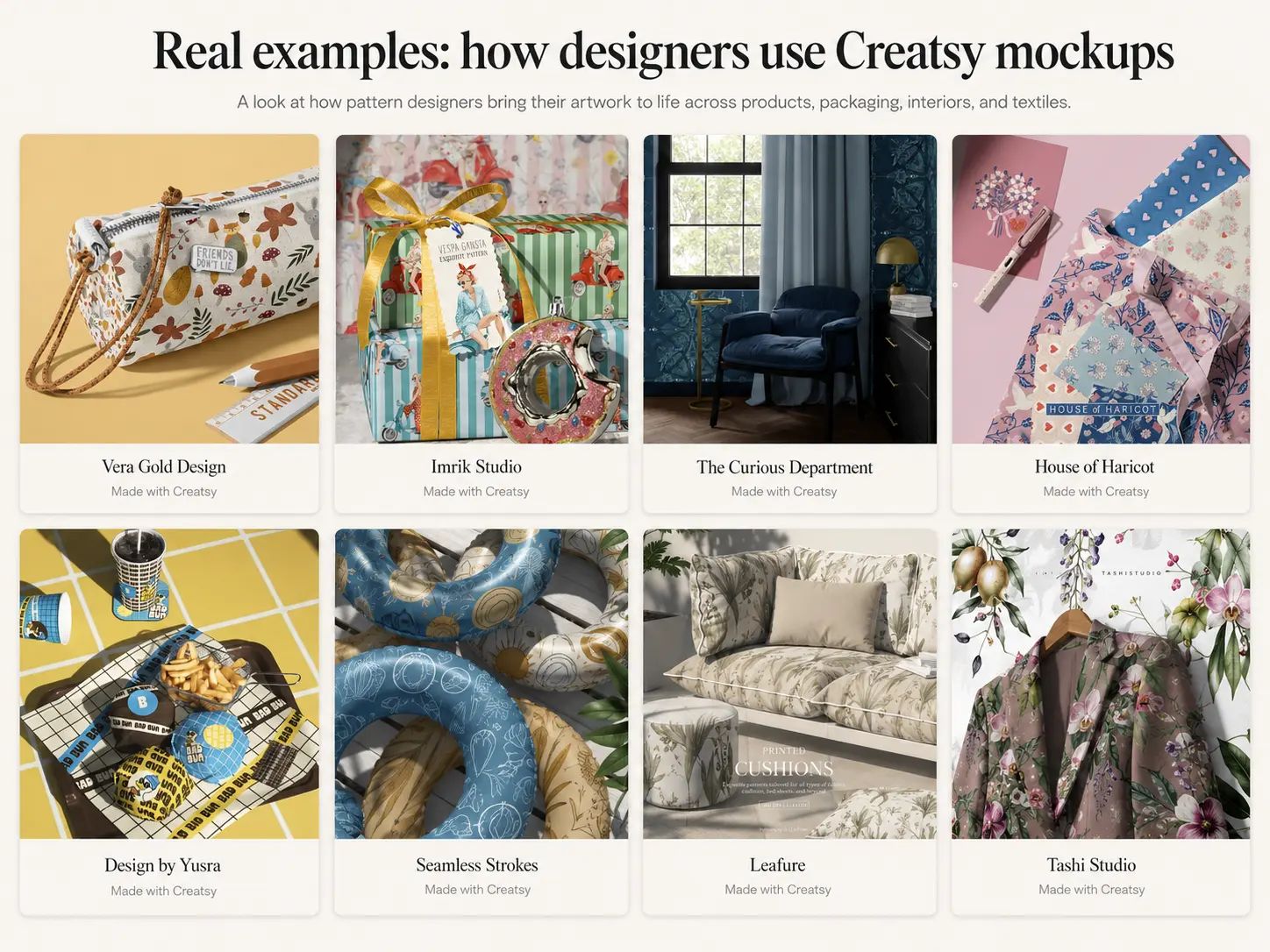
The Made with Creatsy gallery shows patterns moving from flat files into real product contexts: stationery sets, folded fabrics, silk scarves, kids’ bedding, gift boxes, wallpaper rolls, outdoor cushions, and more. The pattern stays the hero; the mockup just shows what it can become, whether that’s a floral turning into a notebook collection, a lemon print becoming fabric, or a botanical mural becoming wallpaper.
Why Creatsy mockups work for pattern presentations
Creatsy mockups are built for designers who need realistic product previews, not flat templates. Many files use layered PSDs and Smart Objects, so you can drop your artwork in while the shadows, highlights, folds, and perspective stay intact, which matters when a repeat has to look natural on fabric, wallpaper, packaging, or apparel.
The categories that tend to help pattern designers most include Fabrics, Kids & Babies, Nursery & Kids’ Room, Bedding, Wallpaper, Home & Living, Furniture, Gift Packaging & Wrapping, Stationery, Apparel, and a set of free mockups. That’s enough range to present a pattern across markets without producing physical samples first.
Final thought: don’t make buyers imagine everything
A flat square repeat is important, so keep it. But don’t stop there. Your pattern was designed for a world beyond the tile: fabric, kids’ clothing, wallpaper, bedding, upholstery, packaging, a real room, a real product. A mockup turns “nice artwork” into “I can see this as a product,” and that’s the moment a design becomes easier to understand, to remember, and to sell.
So present your next collection in three moves: the flat repeat tile so buyers see the structure, the design on a smaller product like swimwear, stationery, or fabric, and then a larger surface like wallpaper, bedding, or a full interior. You can explore Creatsy mockups for pattern designers across fabrics, kids and babies, wallpaper, bedding, furniture, packaging, stationery, and apparel. Your pattern doesn’t have to stay inside a square - show what it can become.
Frequently asked questions
Why should pattern designers use mockups?
Pattern designers should use mockups because they show how a repeat looks on real products like fabric, kids’ clothing, wallpaper, bedding, packaging, and home decor. Mockups help buyers understand scale, product fit, and commercial potential far faster than a flat tile on a white background.
Is a flat repeat preview enough for a pattern portfolio?
A flat repeat preview is useful but usually not enough on its own. It shows the technical repeat, not how the pattern works on real surfaces. A stronger portfolio pairs repeat tiles with product mockups, so viewers see both the structure and the commercial potential.
Which mockups are best for surface pattern designers?
The most useful mockups for surface pattern designers include fabric, wallpaper, kids’ clothing, bedding, stationery, packaging, upholstery, and home decor. The right one depends on the market: choose the surface that shows where the pattern is meant to live.
How should I present a pattern collection?
Show the full repeat tile, a close-up detail, the pattern on fabric, then on a small product, a large surface, and one lifestyle scene. That sequence gives art directors and buyers both technical clarity and the emotional context they need to picture the design as a product.
Can mockups help with pattern licensing pitches?
Yes. Showing one pattern across several product types, such as kids’ clothing, wallpaper, fabric, and packaging, demonstrates range and helps an art director or licensee see how versatile the artwork is. That product context is often more persuasive than the repeat tile alone.